If you've ever been confused about the terms gender identity and sexual orientation, you're not alone. These concepts are often talked about together, but they aren’t the same, and understanding the difference can make a big impact in how you connect with yourself and others.
Whether you’re exploring your own identity, supporting someone you care about, or simply trying to be more inclusive, this guide will help you clearly understand what these terms mean and why they matter.
Let’s Start with You: How Do You Identify?
Take a moment and think about it: how do you describe yourself? Do you feel like a man, a woman, neither, perhaps somewhere in between?
That internal feeling, and sense of who you are, is your gender identity.
Now think about who you’re emotionally, romantically, or sexually attracted to. Are you drawn to men, women, people of any gender, or maybe you don’t feel much attraction at all?
That’s your sexual orientation.
Gender identity and sexual orientation are two completely different parts, but they can interact in ways that shape your experiences, your relationships, and even how others see you.
Understanding Gender Identity: Who You Are
Gender identity is how you experience your own gender on the inside. It doesn’t necessarily match the gender you were assigned at birth.
Some gender identities include:
- Cisgender – Your gender matches the sex assigned at birth.
- Transgender – Your gender is different from the one you were assigned at birth.
- Non-binary – You don’t identify as male nor female.
- Agender – You don’t identify with any gender.
- Genderfluid – Your gender identity shifts over time.
This is something deeply personal. Only you can know your gender identity, and no one else gets to decide it for you.
Some known facts:
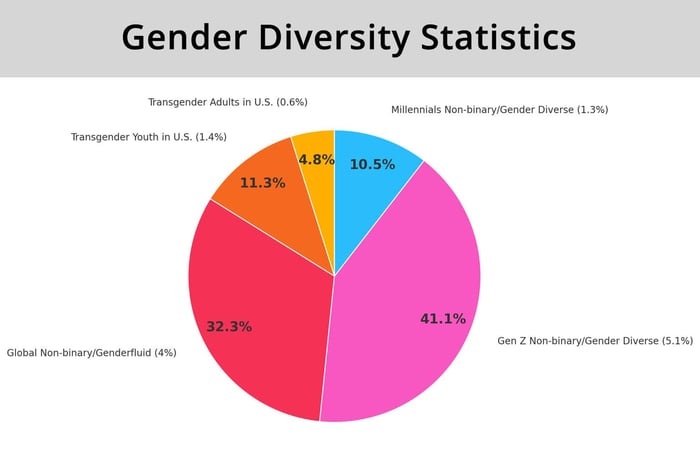
- 1.6 million adults in the U.S. (approximately 0.6% of the adult population) identify as transgender.
— Source: UCLA Williams Institute, 2022 - Among U.S. youth aged 13–17, about 1.4% identify as transgender.
— Source: CDC Youth Risk Behavior Surveillance, 2023 - In a global survey (Ipsos, 2021), 4% of people across 27 countries identified as non-binary, genderfluid, or other than male/female.
- Younger generations are significantly more likely to identify outside the traditional gender binary:
- Gen Z (ages 18–24): 5.1% identify as non-binary or gender diverse
- Millennials: 1.3%
— Source: PRRI Survey, 2023
Understanding Sexual Orientation: Who You’re Attracted To
Sexual orientation is about who you’re emotionally, romantically, or sexually drawn to. This isn’t something you choose; it’s something you discover over time.
You might identify as:
- Heterosexual (straight) – Attracted to a different gender.
- Gay or Lesbian – Attracted to the same gender.
- Bisexual – Attracted to more than one gender.
- Pansexual – Attracted to people regardless of gender.
- Asexual – You don’t feel sexual attraction (or feel very little).
- Queer – A broad, fluid term some people use for their orientation.
Your orientation is only one portion of your whole identity. It can stay the same throughout your life or evolve as you discover and understand yourself.
Did you know that:
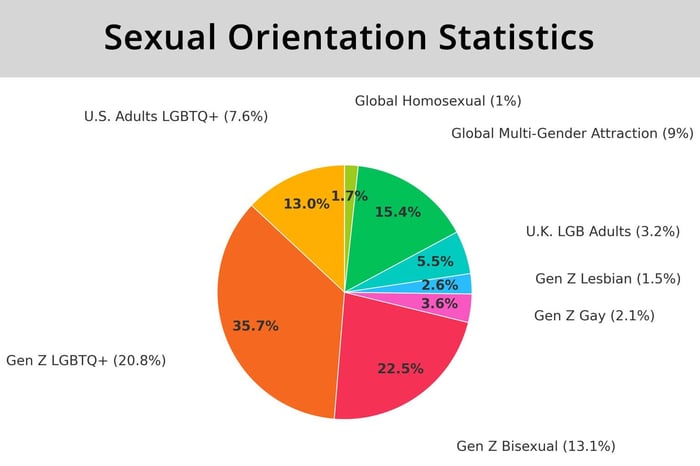
- 7.6% of U.S. adults identify as LGBTQ+, a number that continues to grow annually.
— Source: Gallup, 2023 - Among Gen Z adults in the U.S.:
- 20.8% identify as LGBTQ+
- 13.1% identify as bisexual
- 2.1% as gay
- 1.5% as lesbian
— Source: Gallup, 2023
- In the U.K., 3.2% of adults identify as lesbian, gay, or bisexual (2022), with rates highest among 16–24 year-olds.
— Source: UK Office for National Statistics - Globally, 9% of respondents say they are attracted to more than one gender, while 1% identify as exclusively homosexual.
— Source: Ipsos Global Attitudes Survey, 2021
Why This Difference Matters to You (and the People Around You)
Maybe you’re questioning your own identity. Maybe someone close to you just came out as trans or bisexual. Whatever the case, knowing how gender identity and sexual orientation work can help you feel more grounded and informed.
If you understand these concepts, you’re better equipped to:
- Understand your own identity more clearly
- Support friends or loved ones without making assumptions
- Create a better space for people to feel like themselves
- Challenge stereotypes and outdated thinking
- Avoid confusing or hurtful language
Let’s Look at Some Real-Life Scenarios
Sometimes it helps to see how these concepts apply to real people:
- You were assigned female at birth and feel connected to being a woman. That's your gender identity. You’re into women romantically, that makes your sexual orientation lesbian.
- Your friend Alex identifies as non-binary (they don’t identify as "just" male or female). They’re into people regardless of gender. They call themselves pansexual.
- Your coworker Jamie is a trans man. He was born female, but identifies as male. He’s dating a woman, and he describes himself as straight.
None of these combinations are “weird” or “wrong.” They’re simply different, and perfectly valid.
What If You’re Still Figuring Things Out?
That’s completely okay!
Exploring your gender or orientation is a deeply personal process, and it’s okay if it doesn’t follow a straight path. Some days you might feel certain; other days, unsure, and that’s perfectly normal. You don’t need to rush into labels or justify yourself to anyone. Curiosity is valid. Change is valid. Growth takes time. Give yourself permission to explore, evolve, and just be.
Did you know that:
- About 30% of transgender individuals in the U.S. identify as straight, while 70% identify as LGBTQ+ (e.g., gay, lesbian, bi, pansexual, or queer).
— Source: National Center for Transgender Equality, 2022 - Among LGBTQ+ youth:
- 41% seriously considered suicide in the past year.
- 54% of trans and non-binary youth reported symptoms of depression.
— Source: The Trevor Project, 2023 U.S. National Survey
Things You Can Do to Be More Inclusive and Informed
Whether you're exploring your own identity or becoming a better ally, here are a few steps you can take right now:
- Use Inclusive Language
Say “partner” instead of assuming someone’s boyfriend/girlfriend. Ask about pronouns if you’re unsure. - Don’t Assume
Just because someone looks or acts a certain way doesn’t mean you know their gender identity or orientation. - Listen to People’s Words
If someone tells you how they identify, trust them. It’s their truth, and it deserves respect. - Educate Yourself
There’s always more to understand. Keep an open mind and learn from stories, books, and resources that expand your perspective.
Where You Can Get Support and Learn More
You don’t have to go through your questions or struggles alone. If you’re looking for more info or help (either for yourself or someone else), reach out to these safe and inclusive support organizations.
The Bottom Line: You Deserve to Be Seen
Whether you’re straight or gay, cisgender or non-binary, questioning or confident, your identity is real, valid, and worth honoring. The more you understand the difference between gender identity and sexual orientation, the more empowered you’ll be in your own life, relationships, and community.
This knowledge isn’t just about being “politically correct”, it’s about respecting people’s truths, including your own.