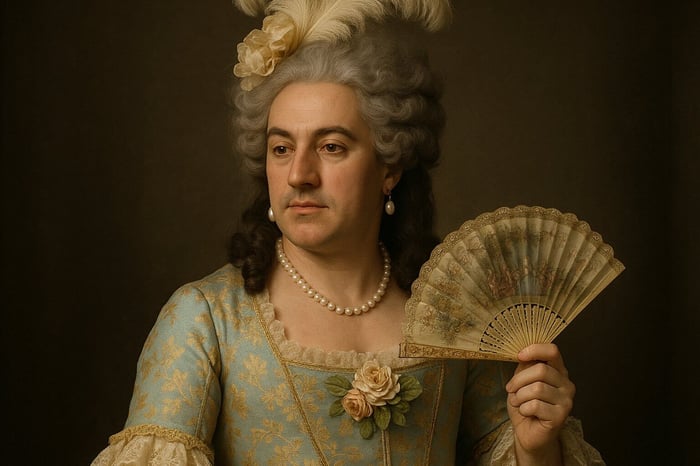
When you think of Versailles, you might picture gold-trimmed halls, extravagant balls, and the powdered elegance of 18th-century nobility. But what you might not know is that behind those opulent curtains, queer love, same-sex liaisons, and secret LGBTQ+ subcultures were not just present, they were thriving.
Let’s travel back to the reigns of Louis XIV (the Sun King) and Louis XVI, and peel back layers of royal formality to reveal the queer currents that pulsed beneath the surface. Have you ever wondered how queer individuals navigated identity, desire, and survival in one of Europe’s most scrutinized and theatrical courts?
Courtly Love, Gender Play, and the Performance of Identity
At Versailles, identity was theater. Nobles dressed in silks, wore powdered wigs, and spent their days performing roles expected of their gender and class. But this constant play-acting also created space for queerness to flourish, especially when performance became indistinguishable from reality.
Louis XIV’s court was famous for its masquerade balls and theatrical productions where gender bending was not only common, but fashionable. Nobles cross-dressed for courtly entertainment, and it wasn’t always just for show.
Costume offered cover. Beneath the mask of “fashion,” same-sex flirtation could take place, sometimes even sanctioned through innuendo and ambiguous codes. These coded performances became a survival strategy, one that queer courtiers used to express attraction without overtly violating social norms.
The Chevalier de Lorraine: The King's Brother’s Lover
Among the most compelling queer figures of Louis XIV’s court was Philippe I, Duke of Orléans the king’s younger brother. He was known at court as "Monsieur".
Philippe was unapologetically flamboyant, frequently seen in lavish silks, pearls, and high heels, and he proudly embraced mannerisms considered effeminate by his contemporaries. But what made him truly exceptional wasn’t just his style, it was his open preference for male companions in a time when same-sex relationships could lead to social exile or worse.
At the heart of Philippe’s romantic life was the Chevalier de Lorraine, a dashing and ambitious French nobleman who became not only his lover but his political confidant and emotional anchor.
Their relationship was widely known within the court, an open secret whispered about in corridors but largely tolerated, albeit uneasily, by King Louis XIV.
While the Sun King was wary of scandal, he seemed to accept his brother’s sexuality as long as Philippe continued to fulfill his duties, including marrying and producing heirs. The Chevalier, however, often pushed the limits of court decorum. He was charismatic but also manipulative, rumored to have wielded influence over Philippe in ways that upset the court’s fragile power dynamics.
During particularly scandalous episodes, such as alleged involvement in court intrigues or conflicts with Philippe’s wives, Louis XIV would exile the Chevalier from Versailles. Yet, these exiles were always temporary. Each time, Philippe would fight fiercely for his return, and their bond would resume as if nothing had changed.
Their enduring connection, spanning decades and surviving courtly politics, public scrutiny, and royal interference, was far more than a mere dalliance. It speaks to the complexity of queer love in high-stakes environments.
For Philippe and the Chevalier, love had to be both defiant and discreet, passionate yet politic.
Their story reveals the delicate dance queer individuals performed within royal life: one could love outside the heteronormative script, as long as the performance of nobility, through marriage, diplomacy, and spectacle, remained intact.
Behind the gilded walls of Versailles, desire lived in the margins, but it lived nonetheless, vibrant and resilient.
Underground Queer Networks and Salon Culture
Court life didn’t exist in a vacuum. Parisian society was abuzz with salons, private gatherings hosted by intellectuals and aristocrats. Many of these salons operated under Enlightenment ideals of liberty, reason, and critique of orthodoxy, which gave rise to discreet yet thriving LGBTQ+ circles.
One such space was Madame de Pompadour’s salon, a cultural hub that welcomed progressive thinkers and performers, including gender-nonconforming individuals and playwrights whose works flirted with queer themes.
These underground networks weren’t just about sex; they were about solidarity. People formed quiet alliances, developed coded language (like Polari in England or argot in France), and protected one another from ruin in a society where “sodomy” was still legally punishable.
Louis XVI’s Court: Surveillance and Scandal
By the time Louis XVI took the throne in 1774, the court was more paranoid than ever. Surveillance was tight, political tensions were rising, and any form of perceived deviance could be weaponized.
Still, same-sex affairs continued in secret. Royal guards, page boys, and even high-ranking aristocrats were caught in what were delicately termed “scandals.” But scandal was also currency at court, gossip moved faster than carriages.
The Affair of the Necklace, a scandal that helped erode public trust in the monarchy and hasten Marie Antoinette’s downfall, was far more than a simple case of fraud. At its center was the cunning and ambitious Countess Jeanne de La Motte, who orchestrated an elaborate scheme involving forged letters, royal impersonations, and complex courtly seductions.
Jeanne manipulated both Cardinal de Rohan, (who desperately sought the Queen’s favor) and her lover, Nicole d'Oliva, a woman who resembled Marie Antoinette and posed as the Queen in a moonlit garden rendezvous. Some accounts suggest that Jeanne’s relationship with d'Oliva went beyond convenience, hinting at a same-sex intimacy masked by the language of partnership and conspiracy.
The plot thrived on gender performance and the fluid use of identity. Jeanne disguised motives, emotions, and even gender boundaries to navigate the rigid, heteronormative expectations of Versailles. In seducing both men and women to achieve her goals, she exemplified how queer energy, through disguise, allure, and transgression, existed even in one of history’s most infamous royal scandals.
What made the affair so scandalous wasn’t just the theft of a necklace worth 1.6 million livres, it was the revelation of blurred lines between appearance and reality, gender and power, love and manipulation.
Living Queer Lives in a World of Appearances
If there’s one lesson from the secret queer life of the French court, it’s this: queerness finds a way. Even under the weight of religion, surveillance, and heteronormativity, LGBTQ+ individuals carved out space for connection, pleasure, and even love.
Yes, these lives were often hidden. Yes, they came at great personal risk. But they existed, and they mattered. And they remind us that queer people have always been here, dressed in velvet, whispering behind fans, dancing beneath chandeliers.
We’ve Always Been Here
Understanding the queer history of the French court isn't just about uncovering hidden secrets, it's about reclaiming a past that was deliberately silenced. These stories aren’t just gossip. They are history. Our history.
And as we continue to fight for LGBTQ+ visibility and rights around the world, looking back it’s a reminder that as queer people we have always existed, even in the most gilded, guarded corners of society.