Table of Contents
- Lesbian Population Density by Age and Country
- Age Distribution of Lesbians When Coming Out
- Percentage of Lesbians Use of Dating Apps
- Percentage of Lesbian Marriages Compared to Gay Men
- Lesbian Reproductive Rights by Country
- Percentage of Lesbians with Children vs Single
- Lesbian Divorces Compared to Gay Men
- Lesbians in the Workforce: Lowest and Highest Discrimination Countries
- Lesbian Careers and Industry Fields
- Lesbian by Race Worldwide
Understanding global lesbian identity requires examining how culture, policy, social norms, and personal identity intersect. Patterns in coming out, family formation, reproductive rights, and workplace dynamics all reflect the influence of broader societal forces.These lesbian statistics present a detailed look at lesbian population density by age and country, along with insights into dating, marriage, race, and legal recognition. Together, the data paints a clear picture of where lesbian visibility is growing, and where it remains constrained.
Lesbian Population Density by Age and Country
Lesbian identification varies across age groups and geographic regions.
This chart reveals higher identification rates among younger women, particularly in countries with progressive LGBTQ+ policies such as the United States, Canada, Australia, and parts of Western Europe. Generational trends are evident, with women aged 18–29 significantly more likely to identify as lesbian or bisexual than older age groups, reflecting greater social acceptance and visibility.
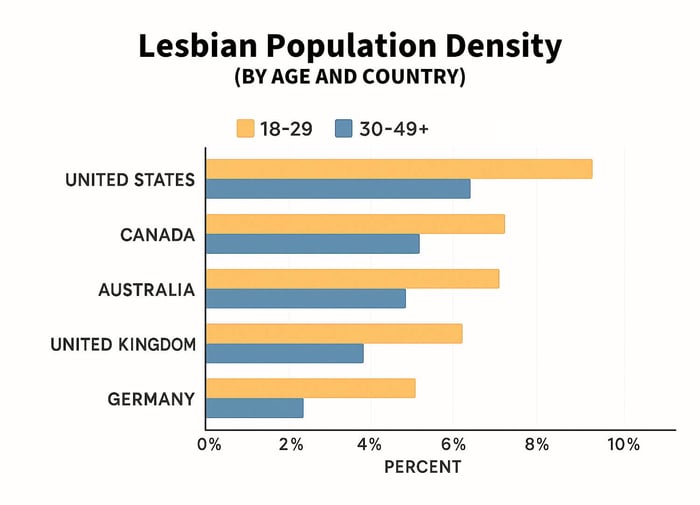
It also exposes sharp contrasts between liberal democracies and more conservative or restrictive nations, where cultural stigma and legal barriers contribute to lower reported numbers, often due not to a smaller lesbian population, but to underreporting and societal pressures.
Age Distribution of Lesbians When Coming Out
This lesbian statistics chart illustrates the age distribution at which lesbian individuals most commonly “come out”. The largest percentage, 41%, do so between the ages of 18 and 24, highlighting a trend of earlier self-recognition and openness in young adulthood. Another 26% come out between the ages of 25 and 34, indicating that many lesbians continue to explore and affirm their identities into their late twenties and early thirties.
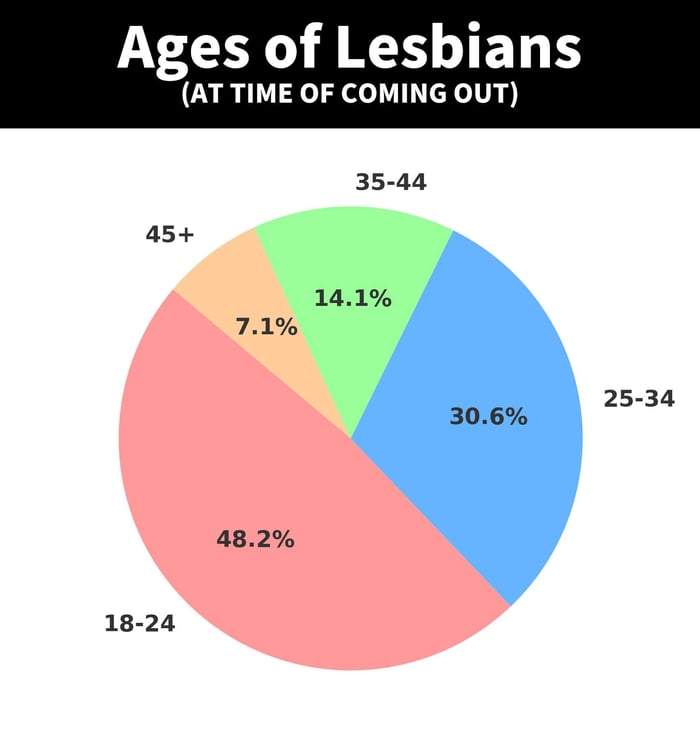
Coming out becomes less common in later years, with only 12% of lesbians coming out between ages 35 and 44, and just 6% after age 45. This pattern reflects how younger lesbian generations, often raised in more accepting social and cultural environments, feel increasingly empowered to live openly earlier in life. It also underscores the importance of systems that make early self-identification more accessible.
Percentage of Lesbians Use of Dating Apps
The chart below visually compares the level of dating app engagement among lesbian women in various countries. Australia ranks the highest, indicating a stronger digital dating culture among lesbians, possibly due to greater acceptance, wider app availability, and more urbanized social environments.
The United States follows closely, reflecting similar trends in technology adoption and LGBTQ+ inclusivity. Countries like Switzerland and the United Kingdom show moderate percentages, suggesting a healthy but slightly more conservative engagement with dating platforms among lesbian communities.
On the lower end, countries such as Germany, the Netherlands, and Canada show a somewhat smaller percentage of lesbians using dating apps. This could stem from factors like regional cultural preferences, the availability of queer-friendly spaces offline, or privacy concerns that discourage digital engagement.
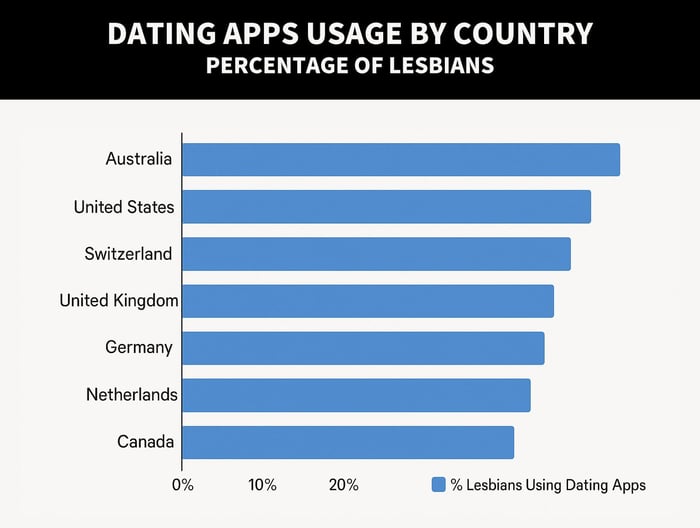
These variations can also reflect generational differences, urban versus rural divides, or how dating apps market themselves to LGBTQ+ users. Overall, the chart highlights the growing yet diverse reliance on digital platforms among lesbians seeking connection, shaped by geography, culture, and social openness.
Percentage of Lesbian Marriages Compared to Gay Men
The chart below illustrates the distribution of same-sex marriages between lesbian couples and gay male couples across seven countries: the United States, Canada, the United Kingdom, Germany, Australia, France, and Spain.
In every country listed, lesbian marriages outnumber gay male marriages as a percentage of total same-sex unions. For instance, in Canada, lesbian marriages account for 60% of all same-sex marriages, while gay men make up only 40%. A similar trend is seen in the UK (58% lesbian vs. 42% gay male) and Australia (57% vs. 43%).
This disparity may stem from several social and cultural factors. Studies suggest that women in same-sex relationships are more likely to seek legal recognition and family stability, particularly when raising children. In contrast, gay male couples may be less inclined to marry, potentially due to different social dynamics, lifestyle preferences, or historical stigma surrounding male homosexuality.
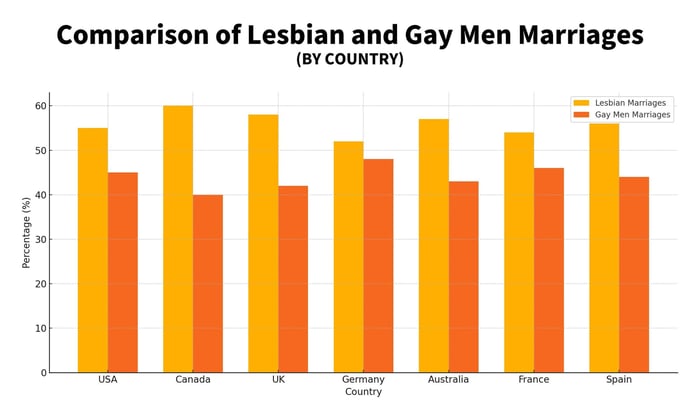
Another factor could be demographic: in many countries, women are slightly more likely than men to identify as LGBTQ+, which could lead to a higher number of lesbian partnerships seeking marriage. Additionally, lesbian couples may be more likely to formalize their unions through marriage compared to their male counterparts.
Overall, this lesbian statistics data suggests a consistent international pattern where lesbian couples are statistically more likely to marry than gay male couples.
Lesbian Reproductive Rights by Country
Lesbian reproductive rights differ dramatically across the globe, shaped by cultural, legal, and political landscapes. These rights encompass access to family planning services, legal recognition of parenthood, and equal opportunities for building families. In many regions, the extent to which lesbian couples can access reproductive technologies and secure legal parenthood is a clear indicator of how inclusive a society is toward LGBTQ+ families.
In progressive countries like the Netherlands and Finland, lesbian couples benefit from comprehensive reproductive rights. These nations provide equal access to IVF treatments, allow joint adoption, and recognize both mothers on a child’s birth certificate. In some cases, altruistic surrogacy is also legally accessible. These inclusive policies reflect a broader commitment to treating all families with dignity and equality, enabling lesbian couples to navigate parenthood with legal clarity and support.
Click Image to Enlarge
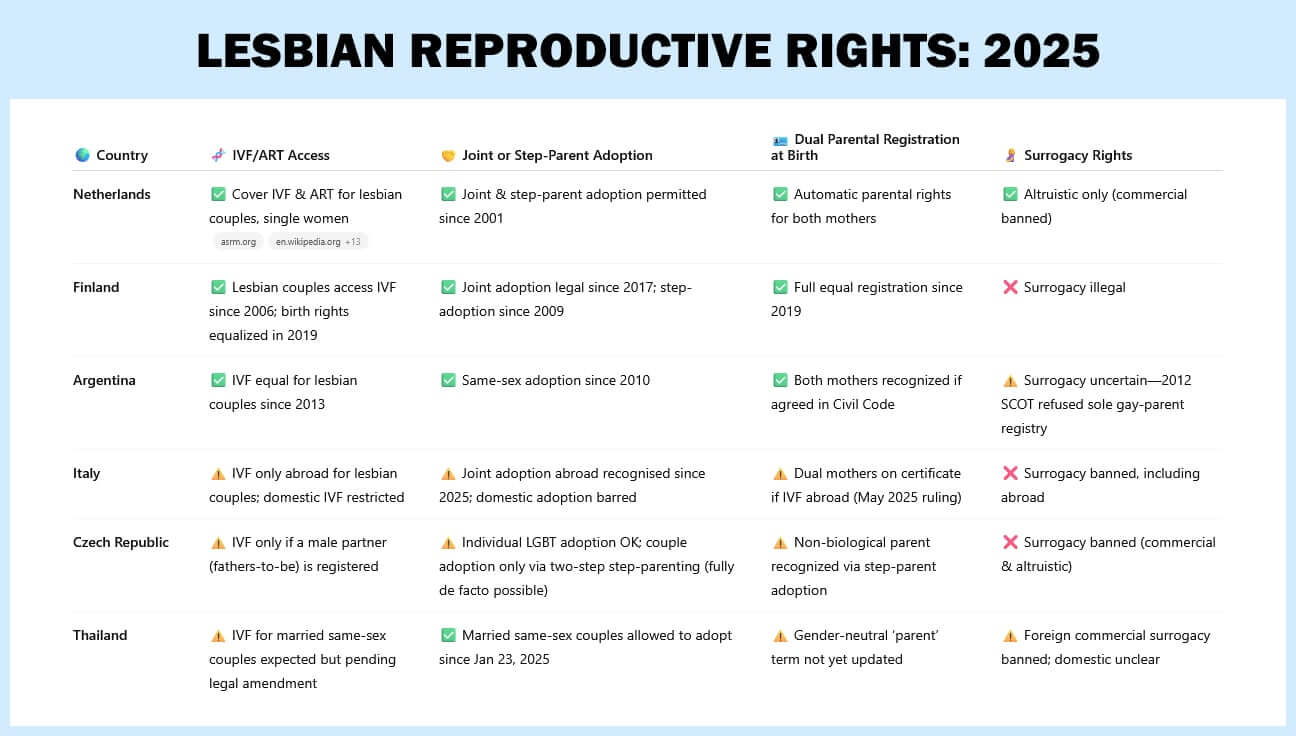
However, in other parts of Europe, such as Italy and the Czech Republic, lesbian reproductive rights remain restricted. While Italy recently began recognizing lesbian parents who underwent IVF abroad, it still limits access to such technologies within its borders. Surrogacy remains illegal, presenting significant challenges for family formation. Similarly, the Czech Republic only offers IVF to heterosexual couples, and adoption rights for lesbian couples involve complex legal processes.
Outside Europe, countries like Thailand present a more nuanced picture. In 2025, Thailand made a notable step forward by legalizing same-sex adoption, a move that signals a shift toward greater acceptance. Yet, it still lacks comprehensive policies on IVF and surrogacy for same-sex couples, leaving many lesbian families in a legal gray area. These partial advances highlight both progress and the need for better and stronger legal protections.
Overall, the global landscape of lesbian reproductive rights reveals stark inequalities. While some nations have implemented inclusive systems that affirm reproductive autonomy, others impose significant legal and logistical barriers. These disparities underscore the continued need for advocacy and legal reform to ensure that all lesbian couples, regardless of geography, have the right to form and protect their families.
Percentage of Lesbians with Children vs Single
Recent global studies show that a significant portion of lesbians identify as single without children, while a smaller but growing percentage are parenting either through previous heterosexual relationships, adoption, or assisted reproduction. On average, approximately 30–35% of lesbians globally are parents, though this varies by region due to cultural, legal, and socioeconomic factors. Countries with more progressive LGBTQ+ family laws (like Canada, the Netherlands, and Sweden) tend to report higher rates of lesbian couples raising children.
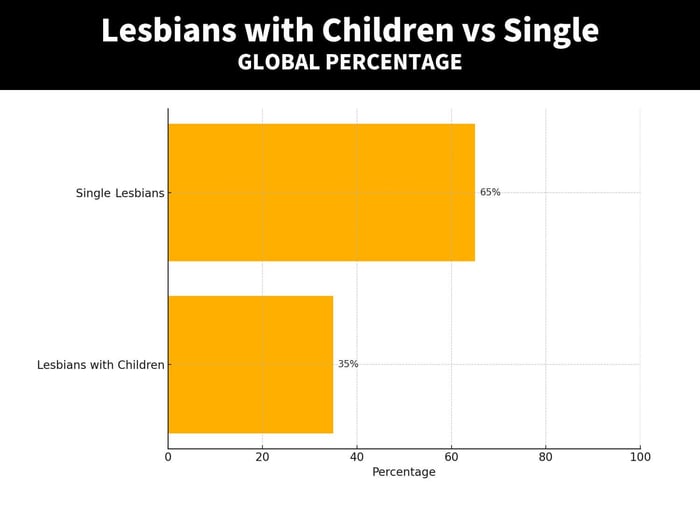
In contrast, around 60–65% of lesbians identify as single and child-free, a reflection of both personal choice and systemic barriers to family-building. In many parts of the world, legal hurdles and social stigma make parenting difficult for same-sex couples, particularly lesbians. This disparity in parental status underlines the ongoing challenges many lesbians face in pursuing traditional family structures, even as social acceptance continues to improve in several countries.
Lesbian Divorces Compared to Gay Men
Research indicates that lesbian couples have a higher likelihood of divorce compared to gay male couples. Data from the U.S., U.K., and Nordic countries reveal higher dissolution rates among lesbian marriages, often linked to emotional intensity, communication patterns, and the societal roles and expectations placed on women in same-sex relationships.
Gay male couples, by contrast, tend to have lower divorce rates. Experts suggest this may be due to greater flexibility in defining relationship norms, such as openness, and possibly less societal pressure to conform to traditional marriage structures. These factors can contribute to longer-lasting unions.
While more research is needed, gendered dynamics clearly influence same-sex relationship longevity. Emotional expectations, social norms, and communication styles all play a role in shaping how lesbian and gay male couples experience marriage and divorce differently.
Lesbians in the Workforce: Lowest and Highest Discrimination Countries
Lesbian professionals face varying levels of workplace discrimination depending on country-specific laws and social norms. Nations like Canada, Sweden, the Netherlands, and New Zealand report the lowest levels, thanks to strong legal protections and inclusive workplace cultures. These environments encourage openness and career advancement.
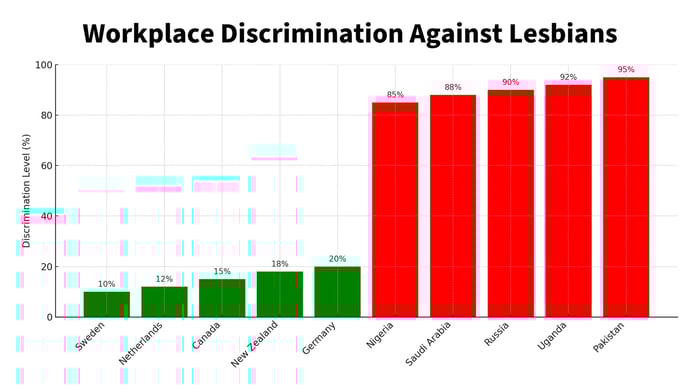
In contrast, countries such as Nigeria, Uganda, Russia, and Saudi Arabia present high risks for lesbian workers. With criminalization, lack of protections, and widespread stigma, many are forced to hide their identities, limiting their safety, job mobility, and mental well-being.
Global disparities show the need for stronger protections and cultural change. While international advocacy and inclusive corporate policies are expanding, true progress requires both legal reform and societal acceptance to ensure lesbians can work freely and safely everywhere.
Lesbian Careers and Industry Fields
Lesbians pursue careers across a wide range of fields, but trends often reflect levels of inclusivity and workplace culture. Professions like education, healthcare, social work, and the arts have traditionally offered more accepting environments, allowing lesbian professionals to work openly and thrive. These fields value empathy, communication, and advocacy, traits often shaped by experiences with marginalization.
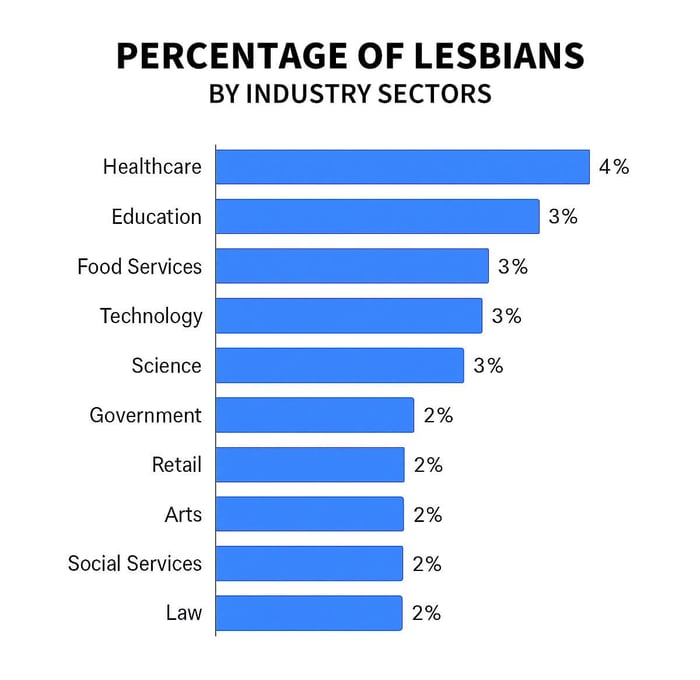
Creative sectors such as film, writing, and design also attract many lesbian professionals due to their openness and opportunities for self-expression. These platforms enable women to challenge stereotypes and reshape cultural narratives. As visibility grows, more lesbian voices are contributing to media, literature, and the arts.
In recent years, more lesbians are breaking into male-dominated industries like tech, finance, and law, aided by global DEI initiatives and shifting professional norms. While progress is evident, challenges such as discrimination and limited leadership access persist. Ongoing advocacy, mentorship, and inclusive policies remain critical to ensuring visibility and success across all careers.
Lesbian by Race Worldwide
The chart below illustrates the racial composition of lesbian individuals globally. It shows that 46% identify as White, 24% as Asian, 21% as Latina, and 18% as Black, revealing strong representation across diverse communities.
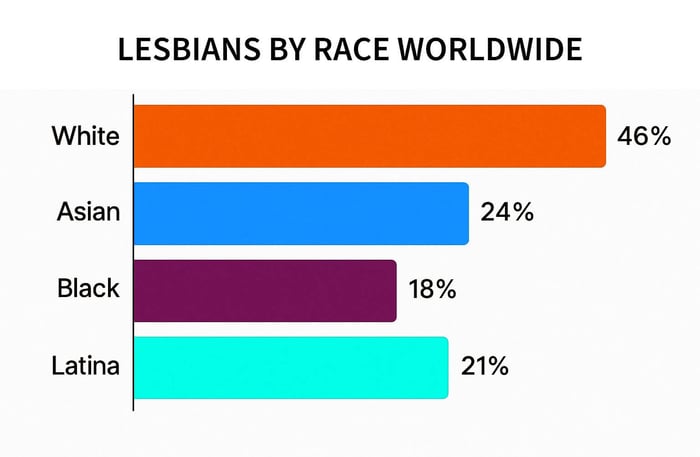
These lesbian statistics numbers reflect more than population size. They highlight differences in visibility, cultural acceptance, and access to data. Higher representation of White lesbians may stem from more open environments in Western countries, while stigma elsewhere can lead to underreporting.
The data encourages deeper exploration into how race and sexual orientation intersect, emphasizing the need for inclusive research and culturally aware global support systems.
Lesbian life varies widely across regions and generations. Geography, law, and culture shape when and how women live openly, form relationships, and access basic rights. While many women benefit from increasing acceptance, others still face barriers and erasure. These lesbian statistics findings highlight ongoing inequalities and the need for global advocacy, legal reform, and cultural inclusion to support and affirm lesbian identities everywhere.