Marsha P. Johnson was more than just a drag queen or a trans icon; she was a fearless pioneer of the LGBTQ+ liberation movement, a tireless advocate for marginalized communities, and a beacon of love and resistance in a time of widespread oppression. Best known for her role in the Stonewall uprising of 1969 and as a co-founder of the Street Transvestite Action Revolutionaries (STAR), Marsha’s legacy continues to inspire activists and allies around the world.
Early Life and Struggles
Marsha P. Johnson was born Malcolm Michaels Jr. on August 24, 1945, in Elizabeth, New Jersey. Raised in a devout Christian household, Johnson began experimenting with cross-dressing at a young age but quickly learned that such expression was dangerous. As a teenager, she moved to New York City with just a bag of clothes and $15, seeking refuge and freedom in the bustling and often brutal streets of Greenwich Village.
It was in New York that she adopted the name Marsha P. Johnson, the “P.”, she famously said, stood for “Pay It No Mind,” a phrase she would often use to dismiss intrusive questions about her gender identity. This phrase also became a signature motto of defiance, encouraging others to live unapologetically.
Drag and Identity
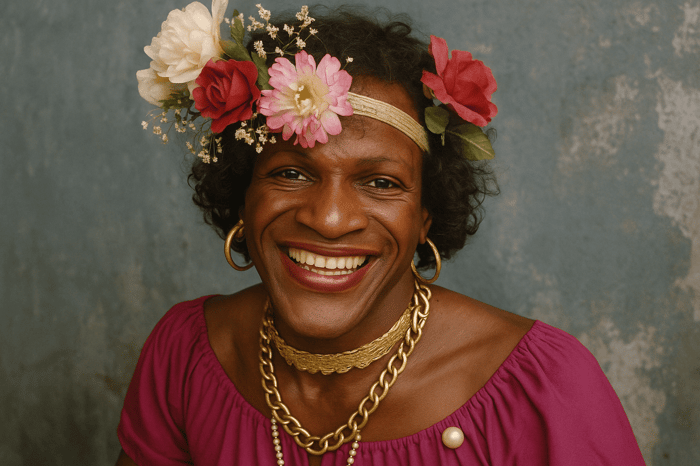
While today Johnson is often remembered as a transgender woman, she personally identified at different times as a drag queen, a transvestite (a then-common term), and gender non-conforming. Her expression defied labels long before today’s broader understanding of gender fluidity. Marsha found community in the drag and gay scenes of New York, performing with the theatrical group Hot Peaches and becoming known for her flower crowns, flamboyant outfits, and ever-present smile.
Though homeless for much of her adult life, Johnson used her visibility to advocate for others. She was deeply spiritual and saw her activism as a divine calling to protect and uplift society’s most vulnerable.
The Stonewall Uprising
The turning point in Marsha P. Johnson’s life (and in LGBTQ+ history) came in the early morning hours of June 28, 1969. At the time, police raids on gay bars were common, and the Stonewall Inn, located at 53 Christopher Street in Manhattan’s Greenwich Village, was a frequent target. On that night, the community fought back.
Though there are varying accounts of who exactly “threw the first brick,” Johnson was undeniably a central figure in the uprising that followed. Alongside close friend and fellow activist Sylvia Rivera, she resisted police brutality and helped ignite days of protest that would become known as the Stonewall Riots. These riots are widely considered the catalyst for the modern LGBTQ+ rights movement.
Founding STAR
In 1970, Marsha P. Johnson and Sylvia Rivera co-founded Street Transvestite Action Revolutionaries (STAR), a radical organization dedicated to helping homeless transgender youth and queer people of color. STAR not only provided shelter and food through the STAR House (originally located in a run-down apartment in the East Village), but it also created a sense of chosen family and community support at a time when most institutions were hostile or indifferent.
The STAR House was revolutionary in itself, run entirely by trans people for trans people. Johnson and Rivera funded it largely through sex work and small donations, further demonstrating their commitment to the cause.
STAR was a precursor to modern mutual aid organizations and LGBTQ+ shelters. Its legacy can be seen today in groups like the Ali Forney Center, The Okra Project, and the Marsha P. Johnson Institute, which continues her fight for Black trans liberation.
Activism and Arrests
Throughout the 1970s and 1980s, Johnson was a visible presence at protests, pride marches, and political actions. She was a member of the Gay Liberation Front and participated in early Christopher Street Liberation Day marches, precursors to today’s pride parades.
Despite her peaceful demeanor, Marsha was arrested more than 100 times, usually for “sex work,” homelessness, or defying gender norms in public. Yet she never let the system break her spirit. Her activism was intersectional long before the term became popular, connecting LGBTQ+ rights to issues of racism, homelessness, and police violence.
In the 1980s, she also became involved with ACT UP (AIDS Coalition to Unleash Power), helping to raise awareness about the AIDS crisis, which was devastating the queer community while government agencies remained largely silent.
Mysterious Death
Tragically, Marsha P. Johnson’s life ended under suspicious circumstances. On July 6, 1992, her body was found floating in the Hudson River near the Christopher Street Pier. Authorities quickly ruled it a suicide, despite witness reports suggesting foul play and the fact that Marsha had been seen hours earlier in high spirits.
Her death sparked outrage and protests from the LGBTQ+ community. In 2012, after renewed public pressure and the release of the documentary Pay It No Mind: The Life and Times of Marsha P. Johnson, the case was reopened. In 2017, filmmaker David France’s documentary The Death and Life of Marsha P. Johnson brought even more attention to her legacy and the circumstances of her death.
Honors and Legacy
In recent years, Marsha P. Johnson has finally begun to receive the recognition she deserves. In 2019, on the 50th anniversary of Stonewall, New York City announced plans to erect a monument to Johnson and Sylvia Rivera in Greenwich Village, the first permanent, public monument in the world honoring transgender activists.
Other tributes include:
- The Marsha P. Johnson State Park in Brooklyn, New York (90 Kent Ave, Brooklyn, NY 11211), renamed in 2020.
- Marsha P. Johnson Institute, a nonprofit that protects and defends the human rights of Black transgender people.
- The Marsha P. Johnson Center for Civil and Human Rights, currently in planning stages, aims to provide cultural, educational, and advocacy services.
- A digital memorial hosted by GLAAD and LGBTQ History Month, and Johnson’s inclusion in national and global curriculum about LGBTQ+ rights.
Her message continues to resonate: Pride was (and is) a protest. And the fight for liberation must always include those at the margins.
Final Thoughts
Marsha P. Johnson’s life reminds us that real change often begins with the bold, the brave, and the unrelenting. She was a Black, queer, unhoused person living at the intersection of multiple oppressions, yet she radiated joy and fought fiercely for justice.
In a time when LGBTQ+ rights continue to face legislative and cultural threats, Johnson’s example is more important than ever. Her legacy lives on not just in memorials, but in every act of resistance, community care, and unapologetic authenticity.
To honor her memory is to keep fighting for a world where every trans person, especially Black and Brown trans people can live freely, safely, and with dignity. Or, as Marsha might say, “Pay it no mind” and keep pushing forward.
1969 T Shirt

$29.00
Celebrate the pivotal year of the Stonewall riots with our 1969 T-Shirt. This powerful statement piece honors the birth of the modern LGBTQ+ rights movement while showcasing your pride. The vibrant rainbow design symbolizes unity and resilience—wear this historic tribute… read more